Monday, February 26, 2007

Mitsubishi acquires 50% Kangean Block from Energi Mega

Japan's Mitsubishi Corp is scheduled to sign sales & purchase agreement (SPA) to acquire 50% participating interest in Kangean Block from EMP Kangean, a subsidiary of listed energy company PT Energi Mega Persada Tbk at around USD360 million Tuesday, Feb 27. EMP will use the proceeds to reduce its debts.

"The initial schedule for the signing of SPA was Monday night. But there are some issues to settle," an investment banker close to the deal said.
Few weeks ago, KUPFEC from Kuwait was predicted to win the divestment. "KUFPEC was aggresive but Mitsubishi submits better offer," he said.
Mitsubishi is one of the most aggresive energy investors in recent years. The company is also in the short list of investors to acquire 30% shares in KPC and Arutmin Indonesia, both are subsidiaries of Bakrie-controlled PT Bumi Resources Tbk.
Mitsubishi is also the largest shareholder (60%) in a mini LNG plant project in partnership with Pertamina and Medco called Senoro LNG.

Labels: , ,


READ MORE!!!

Friday, December 22, 2006

Tata, front runner to control KPC-Arutmin

Tata, BHP, and Mitsubishi are competing to acquire 30% shares of KPC and Arutmin. But Tata is reportedly the strongest candidate. May be it's not USD1 billion. "It's way too expensive for 30% of both coal mining companies. It's a kind of prop-up share price," one analyst at local brokerage firm said. "But, it's depend on the side agreements, let say on coal off-take. It could USD1 billion if the buyer will have control over marketing or such off-take agreement," another analyst said.

Labels: , , , ,


READ MORE!!!

Monday, December 11, 2006

Mitsubishi won EPC for Senoro LNG

Mitsubishi won USD600 million EPC contract to build LNG train in Senoro, Central Sulawesi, Investor Daily reported.

Labels:


READ MORE!!!

Sunday, November 19, 2006

Debt & equity market highlights

PT Bank Lippo Tbk finally listed the US$200 million bond arranged by UBS in Singapore Stock Exchange. The proceeds would be used to finance the bank's commercial and consumer lending, and strengthen its capital.

Meanwhile, PT Bank Negara Indonesia Tbk had secured US$150 million syndicated loan from 12 banks & financial institutions to refinance debts. ABN Amro, Bano of Tokyo Mitsubishi UFJ, State Bank of India, Burgan Bank- Kuwait, The Arab Investment Company, Bank Muscat, National Bank of Dubai, Shanghai & Commercial Savings Bank, Mizuho & Standard Chartered are members of the syndication.
Pakuwon Jati Finance BV, a wholly-owned subsidiary of property company PT Pakuwon Jati Tbk registered in Amsterdam, Netherland, had issued US$110 million bond (12%, maturity 2011). The bond, listed in Singapore Stock Exchange, would be used to refinance debts and finance the acquisition of PT Artisan Wahyu.

Labels: , , ,


READ MORE!!!

Saturday, September 09, 2006

Bumi deal screwed you up?

JSX asked PT Bumi Resources Tbk of whether the announced US$3.25 billion acquisition price of its assets by PT Borneo Lumbung Energi-Renaissance Capital was the final price? JSX raised the question, investors as well, because Bumi called the collapse of the deal mainly due to disagreement on the final acquisition price.
No clear-cut explanation from both Bumi and Renaissance. But let me give you the likely answer.

The purchase consideration of coal companies (KPC, Arutmin & Indocoal) was US$3.25 billion on debt-free basis, subject to further adjustments, which were expected in May (when Credit Suisse launch the US$2.1 billion fund raising) to amount to approximately US$250 million.
So, in many documents, the expected final price was US$3 billion (excluding US$100 million for working capital & transaction costs). That was early May. Financing plan was then based on the US$3.1 billion cost. The source of funds: US$1 billion of equity from Borneo (consisted of US$300 million plus US$700 million of Borneo Notes issued to UOB) and US$2.1 billion debt to be raised by Credit Suisse (consisted of US$1.1 billion senior notes and US$500 million junior notes).
So, some people (mainly advisors & lenders/investors in Credit Suisse deal) have been aware of the US$3 billion price (max) to be paid to Bumi shareholders. Borneo was reportedly deposited nonrefundable US$120 million down-payment (even though recently Bumi announced the fund would be returned to Borneo).
Under the SPA between Bumi & Borneo, Bumi was also obliged to repay all outstanding indebtedness owed by the coal companies and part of purchase consideration will be used by Bumi to discharge loans owed by Bumi to each of Mitsubishi, Glencore, and PAMA.
And for the transferred rights and obligations, novation was needed of marketing advisory contracts with Mitsubishi & Glencore and consulting deed with PAMA. Condition precedents were: (1) shareholders' approval (obtained in May 17), (2) consents required under the CCOWs or from relevant Indonesian government bodies, and (3) no events of defaults under existing financing documents.
But later of the month, investors got information that buyer was expecting final price of US$2.7 billion to US$2.8 billion which equals to US$400 million to US$500 million adjustment from the purchase consideration. Why? The buyer seems realized the real value of coal assets were not as high as expected combined with difficulties to raise enough funds in the equity capital side.
The expected closing period of the deal failed to materialize in late June as a result. In that month, director general of coal of the energy ministry sent a letter of default on royalties payment at KPC. Tax office is also reportedly sent two warning letters to KPC on unpaid taxes amount to US$40 million. The stories on Bumi's EBITDA for first half below analyst expectations also put more pressure on buyer, lender, and investors. In May, Credit Suisse told investors (when it launch US$2.1 billion financing) that estimated EBITDA for coal companies in 2006 at US$583 million. But in July, investors got the information of well-below epectations EBITDA of only US$118 million at KPC and Arutmin.
Confronting all the problems, the buyer (under pressure from potential lenders) cut further the price offered to unknown exact figure even though some says at US$2.5 billion as the final price (after the adjustments). Some even says at US$2.2 billion to US$2.3 billion.
Apart of the deal, Bumi announced various initiatives including its claim to work with South Africa's SASOL to develop a multi-years-multi-billion dollar coal-to-liquid (CTL) business only to face SASOL's denial.

To be followed...

Labels: , , ,


READ MORE!!!

Wednesday, August 30, 2006

ACOM & Tokyo-Mitsubishi acquire Bank Nusantara Parahyangan

ACOM Ltd and Bank of Tokyo-Mitsubishi UFJ to acquire more than 50% shares of PT Bank Nusantara Parahyangan at 8 billion yen.

ACOM and BTM UFJ wrote to JSX today that both companies are in negotiation to buy Bank Nusantara, a bank with total asset of Rp2.9 trillion as of June 30, 2006. The bank is controlled by Hermawan family through various companies at around 49%.

Labels:


READ MORE!!!

Tuesday, August 29, 2006

Bumi 'Worthless' Resources

Below are comments of various investment bankers on the collapse of PT Bumi Resources Tbk US$3.2 billion divestment of KPC and Arutmin to PT Borneo Lumbung Energi.

Question: what kind of future Bumi would have?
Answer: Bumi has window of about two months to sell the coal assets at a lower price. After that, KPC operations will collapse and the coal assets will become unsellable. Then Bakrie group will have no more cash cow.
Q: Do you think someone would be able to buy the assets?
A: It's too overwhelming now. Someone should persuade 10 banks & hedge funds who are already inside the Credit Suisse First Boston (CSFB) US$800 million to roll into some kind of Mezzanine, bring in three or four banks to lend an additional US$600 million, and assemble another US$1 billion from several investors...
Q: Even so, that guy would face similar problems with Renaissance?
A: The buyer has to restructure the contracts with Thiess, PAMA, Glencore and Mitsubishi which are sucking out all the cash. It's all too much, nobody will consider it's worth all that pain and effort...
Q: But Bumi management said, they're gonna sell minority shareholding, continue the divestment to guys like Mitsubishi?
A: I don't think so. I think Bumi, again, trying to fabricate some positive news to lift the share price. They have nothing left to offer to Mitsubishi. Nothing left to offer anyone, except the whole thing in one go...
Q: So, what would happen with Bumi shares once JSX lift the trading suspension?
A: Guess yourself.
Q: By the way, what will happen with US$200 million Willow Finance Eschangeable Bond, exchangeable into majority shares of Bumi Resources shares in September mostly held by hedge funds? What will they do?
A: No idea. Tighten your seatbelt!

Labels: , , , ,


READ MORE!!!

Thursday, August 24, 2006

Matindok LNG project so far, so so!

State-owned oil and gas company PT Pertamina (Persero) announced another plan yesterday on its long-delayed liquefied natural gas (LNG) project in Central Sulawesi with Matindok block at the center of it. But the project has been downsized significantly.

As reported by Tempointeraktif.com, Pertamina has two potential partners in the Matindok LNG project, Mitsubishi and Australia Energy. This week, Pertamina would announce the LNG buyers to confirm the project's kickoff. Buyer would be the key financing source for the project (capable to produce 2.5 million tones/year of LNG). Total investment would be US$600 million, of which Pertamina will contribute up to 20%.
The discovery of Donggi field, Matindok and Senoro in Central Sulawesi was initially considered giant with estimated reserves of 22 trillion cubic feet (TCF), lot bigger than Arun in Aceh. In January 2003, Pertamina's then president Baihaki Hakim announced what he called the milestone for the company of a plan to build two LNG trains with US$1.7 billion investment plus petrochemical complex and gas to liquid (GTL) plant in the area.
Months later, Pertamina decided to delay the marketing of the gas on after test wells showed less gas than estimated. But in June 2003, Pertamina and Sri Gas notified Rentech (associate company of Sri Gas) that it has third-party interest to funding 16,000 bpd GTL plant in Matindok.
Pertamina sends stronger signal of less gas reserves in November 2005 when then deputy president of Pertamina Mustiko Saleh admitted that Pertamina would build the LNG plant in Senoro with PT Medco Energi International Tbk. One LNG train only, Mustiko said that time, with Senoro field (Pertamina 50% and Medco 50%) and Matindok (Pertamina 100%) as the source of natural gas for the LNG plant. Combined reserves estimated in the three fields (Senoro, Matindok & Donggi) was 9.6 TCF.
So, what about the petrochemical complex and GTL project? No news so far.

Labels: , , ,


READ MORE!!!

Tuesday, August 15, 2006

Banten gubernatorial race

Hold your breath for the Jakarta gubernatorial race which is a year away. Let's talk about the breathtaking race in the newly established Banten province at the western tip of Java island only weeks away. Who are the candidates?

Three pairs to contest:
First, Rt Atut Chosiyah (Golkar) endorsed by PDI-P as governor candidate. She won the PDI-P Banten chapter convention, beating PDI-P's own cadre and popular artist Mrs Marissa Haque (PDI-P legislator). Mrs Atut also won Golkar Party's convention in Banten to make her the front runner in the election.
Second, Dr Zulkieflimansyah (legislator from PKS). His running mate is Mrs Marissa Haque (PDI-P).
Third, Tubagus Iman Aryadi (Golkar executive), endorsed by president SBY's Partai Demokrat.
The election is worth attention as Banten is the stronghold of Golkar party which won the 2004 election with 16 seats at the local legislative (DPRD), followed by PDI-P (12), PKS (11), Partai Demokrat (8), and PPP (8).
Banten is the home of many multinational investments. Cilegon regency is the largest center of chemical industry in Indonesia. Mitsubishi Chemical, for example, operates the largest purified therepthalic acid (PTA) plants of South East Asia in Cilegon regency. Chandra Asri (olefin center), Titan's PENI (polyethylene), Tri Polyta (polypropylene), Asahi Chemical's EDC to PVC plants, Cabot's carbon black, Amoco Mitsui's PTA plant, Polyprima's PTA plant, Polychem's glycol, Bayer MaterialScience, etc. Cilegon is also the steel-related industry center with the largest steel manufacturer PT Krakatau Steel and Australia's BHP Steel facilities there.
The much-talked-about Bojonegara port is also there with efforts to make it a special economic zone (SEZ). The Merak port is main access linking Java and Sumatra islands.
Banten raised public's attention on social issues when Tangerang, Banten's most populous municipality, under the spotlight after the issuance of a controversial bylaw to eradicate prostitution in 2005. Bylaw No. 8/2005 bans people in public places, places visible from the street or in red-light districts, from persuading or coercing, either through words or gestures, others into acts of prostitution.
The municipality's council also promulgated bylaw No. 7/2005 which bans the distribution and the sale of alcoholic drinks, except in three to five-star hotels and licensed restaurants for on-the-spot consumption.
There's so much at stakes, but I have no clues in which directions these governor candidates would take the province to. Anybody?

Labels: , , , ,


READ MORE!!!

Wednesday, May 24, 2006

Kalla, The Shinkansen

Vice President Jusuf Kalla started his official visit to Japan today, just few weeks after visiting China. One of his agenda will be to renegotiate the on-and-off Jakarta MRT system with Japan Bank for International Cooperation (JBIC).

Kalla is the like of Shinkansen, Japan's bullet train. He's fast, in action and talk. He's everywhere, easy to entertain journalist's question however controversial the topic. Just days before he left Jakarta for Beijing, Kalla made clear to everybody that it would be costly to let the Japanese funding the MRT project even though JBIC offered zero interest loans. He supported the establishment of a consortium of state-owned companies to work with China's companies instead.
Yesterday, just before the aircraft off the ground to Japan, state minister for national development planning Paskah Suzetta admitted one of the agenda during the visit will be a meeting between Kalla and JBIC governor on MRT funding.
For ordinary citizens and commuters, it's not a problem if Japan or China will finance the MRT as long as the ticket would be fair and could be in operation ASAP considering the crazy traffic jam in the city. Jakarta needs the kind of Shinkansen. Kalla should match his Shinkansen-speed-statements and actions, I think.
Other projects to be discussed are, among others, the Asahan hydropower plant project and infrastructure for Tanjung Priok seaport. Kalla will also meet executives of car manufacturers, Mitsubishi and Toyota. Kalla's family business hold the agency of both cars for East Indonesia region, but I do believe he will talk about family business there. He would try to lure them into the country, produce more cars in Indonesia for export market. I believe both Mitsubishi and Toyota are prepared to drive in more investments. But they need Shinkansen-speed of bureaucracy to settle the pending problems.

Labels: ,


READ MORE!!!

Saturday, May 20, 2006

US Auto giant to invest US$1.4bn in Indonesia

An automotive manufacturer from United States is in talks with Indonesia government to invest an integrated car production facilities in the country with investment up to USD1.4bn, the largest automotive investment committment so far.


Detik.com quoted Muhammad Lutfi, head of Investment Coordinating Agency, saying the US company would produce cars in the range of 1,000 cc to 2,000 cc cyllinders with installed capacity up to 200,000 units per year.
Lutfi didn't disclose the name of the company but admitting Indonesia and Thailand are now competing to bring in the investment. Thailand is considered a better place for investment for automotive giants mainly due to its more relax luxury cars tax system.
But Indonesia is a big market with strong demand. Last year, the car sales reached its record high of 530,000 units.
Indonesia is not a place of choice for US auto manufacturers as none of Ford or General Motors made significant investment here. Japanese car manufacturers are the dominant players in the market with Toyota, Suzuki, Honda, and Mitsubishi as the leading brands.

Labels: ,


READ MORE!!!

Monday, April 17, 2006

Mitsubishi Chemical expand Indonesia facility US$260 million

PT Mitsubishi Chemical Indonesia, a wholly owned subsidiary of Japan's Mitsubishi Chemical, will expand its purified therephthalic acid (PTA) plant in Merak, Banten province, Indonesia with additional investment of US$249.75 million.
PTA is the main raw material for polyester staple fiber (for textile manufacturers) and PET resin (plastic raw material). PTA is the preferred raw material used to produce Polyethylene Terephthalate (PET) or polyester. The major applications for polyester are in fiber, bottles, films and molded containers. In the textile industry, polyester, alone or in a blend with cotton, wool or other synthetic fiber, is used in fabrics for clothing and home furnishings. For industrial markets, woven polyester fibers are used in automotive tire cord and seat belt application. Polyester resins are also widely used in molded containers for food, beverages and mineral water. Additionally, polyester films is used as a recording medium for audio and video tapes and as film in medical X-ray equipment.
Mitsubishi currently operates a 650,000 t/y PTA plant in Merak, the largest in Indonesia. The new plant would have installed capacity of 400,000 t/y.
Is this the sign of awakening of Indonesia's chemical industry after years of slowdown? What's happened with other PTA producers such as PT Polysindo Eka Perkasa, PT Amoco Mitsui Indonesia, PT Polyprima Karyareksa, and Pertamina?
Await my special report on Indonesian PTA and chemical industry...my favourite topic.
Mitsubishi Chemical's PTA plants are located in four countries. Japan with 250,000 t/y, South Korea through Sam Nam Petrochemical Co (1.6 million t/y), Indonesia (650,000 t/y) and India (470,000 t/y). Besides the PTA, Mitsubishi also operates a PET film plant in Merak with installed capacity of 20,000 t/y.
Mitsubishi is the largest PTA producer in Indonesia. Other producers are:
- PT Polyprima Karyareksa = 480,000 t/y
- PT Amoco Mitsui Indonesia = 350,000 t/y
- PT Polysindo Eka Perkasa = 350,000 t/y
- PT Pertamina = 225,000 t/y
It brings the country's total PTA capacity at 2.1 million tones per year. With conversion factor of 670 kg of paraxylene to produce 1 ton of PTA, Indonesia needs at least 1.3 million t/y of paraxylene. The problem, Indonesia has only two aromatic centers producing paraxylene with combined capacity of 775,000 t/y leaving almost half the demand from import. So why Mitsubishi wanted to expand PTA plant in Indonesia without enough domestic supply of paraxylene? The new plant would bring Mitsubishi's capacity to 1.05 million t/y which translates to 670,000 t/y paraxylene consumption.

Labels: , , , ,


READ MORE!!!

Wednesday, March 15, 2006

Petronas-Exxon-Pertamina: Lessons learned

While some Indonesians, especially political pundits, bussy to reject ExxonMobil as the operator of the giant Cepu oil field, Malaysia's Petronas quitely opens its first gas station in Cibubur, near Jakarta. Petronas is the second multinational to open gas station in Indonesia after Shell, the super major along with ExxonMobil and Beyond Petroleum (BP).
We, Indonesians, are always jealous with Petronas. Those who loves Formula One easily noticed Petronas in one of the only 11 teams competing in the racing. Their existence would significantly be boosted with their recently announced plan to be the largest player in retail market of fuels in Indonesia.
Petronas used to learn from Pertamina, Indonesia's state-owned company. The Malaysian even adopted the production sharing contract (PSC) system in oil and gas business. They modified that, off course. In less than two decades, Petronas emerged as one of the largest companies in the oil and gas business. It has ventured into various countries, become a global oil and gas player.
What's wrong with Pertamina? Why Petronas managed to surpass Pertamina in almost every aspects of the business? A simple comparison: Pertamina booked net profit of around US$1.3 billion last year, while Petronas 10 times Pertamina's. Pertamina's oil production was 140,000 barrel per day, while Petronas at 567,000 barrel per day.
Can we learn something from Petronas?
Partnership. No way that Petronas could become a world player without partnership with other global players such as Chevron, Mitsubishi, ExxonMobil or BP.
Under production-sharing contracts, ExxonMobil's 600 wells account for about half of Malaysia's oil production and two-thirds of Peninsular Malaysia's natural gas production. Petronas Carigali Sdn. Bhd., a subsidiary of Petronas, is a co-venturer in all but two of the 11 fields operated by ExxonMobil.
ExxonMobil Exploration and Production Malaysia Inc., (formerly known as Esso Production Malaysia Inc), is the largest oil producer in Malaysia and largest supplier of gas to Peninsular Malaysia, producing approximately 280 thousand barrels of oil and 1.4 billion cubic feet of gas per day.
Building on experience, Petronas has extended its reach by forming ventures with ExxonMobil and other multinationals to explore for oil and gas in Africa, the Middle East and Central Asia. The highlight is the Petronas and ExxonMobil membership in the $3.5 billion Chad Project (ExxonMobil interest, 40 percent; Petronas 35 percent; and Chevron, 25 percent).
Petronas is also a 15 percent interest holder in ExxonMobil's Block 24 offshore Angola and Block 214 offshore Nigeria.
Suprisingly, those who oppose ExxonMobil and insist to have Pertamina as the leader in Cepu project, tend to use Petronas as the role model of nationalism in developing the country's natural resources. I'm afraid these guys use the wrong model or they just don't want to read or just to make the case against government.

Labels: , , ,


READ MORE!!!

Monday, March 06, 2006

Pertamina claimed Japanese funding for Cepu

Pertamina was optimistic that it could get funding support from Japan through Japan Bank for International Cooperation (JBIC) and Mitsubishi for the giant Cepu oil field.
Deputy president director of Pertamina Mustiko Saleh said the company has all necessary support for the project including foreign banks which are ready to lend money for Cepu project.
"Long queue of banks behind us. JBIC, Mitsubishi, and others," he told parliament members today.
Pertamina was seems trying to gather more support and political pressures from the House of Representative (DPR) as government might appoint ExxonMobil as the operator for Cepu block. The company insists it could operate the block, or at least alternatingly with Exxon for five years each. But government rejected the proposal saying it would complicate the operation. Government previously raised concern over Pertamina's financial capability to operate the block.
Total investment for Cepu project is expected to reach US$2.5 billion, of which Pertamina should provide 45% (around US$1.1 billion). Pertamina argues that US$50 million to US$100 million from the company would be enough for the first stage of the project.
A cabinet meeting last Friday failed to make decision on Cepu operator because, among others, of the financial issue of Pertamina.
The planned shareholder meeting to make decision on Pertamina's investment has been postponed again to March 15, give enough time for the company to maneuver on the Cepu settlement. Government also postponed the replacement of current board of directors.

Labels: , ,


READ MORE!!!

Tuesday, August 16, 2005

Aceh Deal & The Aftermaths

Noted economist Faisal Basri said that the peace deal signed yesterday by Indonesia government and Free Aceh Movement (GAM) has long-term snowball effects for the country as other natural resources-rich provinces could ask similar treatment.

“This is more than just a federal system. This is similar to Scotland. No wonder GAM signed that. But this deal will be employed by Papua to demand even higher than Aceh and we can’t just stop it,” Faisal quoted by Kompas today.

Under the peace deal, Aceh will have authority to raise loans from other countries, impose different interest rates than Indonesian Central Bank, charge local tax, full authority on marine resources, develop and manage all seaports and airports, and most of all to get 70% of hydrocarbon and other natural resources.

Many questions remain unanswered though. On foreign loans, it is not clear whether the deal give Aceh no veto from central government as under the existing law, local administrations are allowed to get foreign loans only with central government's approval.

On different interest rates, it is not clear whether Aceh will have their own central bank and currency accordingly. Details of local tax, profit sharing of hydrocarbon, and infrastructure management will also reshape the way local administration react to Aceh Peace Deal.

A successful peace agreement this time, surely could smooth the way for a $5 billion internationally-backed reconstruction programme in Aceh, where December's tsunami left some 170,000 people dead or missing and destroyed much of the infrastructure.It would also be a plus for investors looking for stability in the world's fourth most populous country.

Peace in Aceh might even reduce piracy in the Malacca Strait—one of the world’s most important shipping lanes, between Indonesia and the southern tip of Malaysia—as well as diminishing an militant insurgency in southern Thailand, since many of the Malacca pirates, and the Thai insurgents’ arms, are said to come from Aceh.

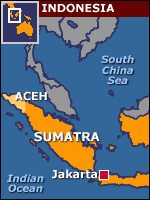
Peace deal will also smooth logging activities in Aceh and help local pulp and paper industry in time of tight wood supply. There are eight companies with license to cut trees in Aceh. PT Krueng Sakti is the largest with concession area of 115,000 hectare, followed by PT Raja Garuda Mas Lestari with 96,500 hectare. Raja Garuda Mas is one of the largest pulp and paper producer in Indonesia. (See Map)

But the deal could lead to other complicated problems and potential uprising in other natural resources-rich areas, especially West Papua which has strong separatist movement like Aceh. In June last year, 20 US senators wrote a letter to Kofi Annan, UN secretary general, urged him to appoint UN Special Representative to Indonesia to monitor and report on the situations in Aceh and Papua.

Talking about hydrocarbon, Aceh was natural gas-rich province, home to the first liquefied natural gas (LNG) plant in Indonesia. The plant, established in 1970s, has six trains with installed capacity of 12 million tones per year. ExxonMobil Oil Indonesia (EMOI) Inc supply gas to the plant from its gas fields in Lhoksukon and North Sumatra Offshore (NSO), both in Aceh territory.

But since 1995, output from those fields decreased significantly due to depleting reserves. As a result, the LNG plant, operated by PT Arun NGL (a joint venture between state-owned oil and gas company Pertamina, Exxon, and Japanese companies) is only running at 40% capacity. Last year, three out of six LNG trains in dormant. Next year, most likely only two trains will be in operation. In less than a decade, gas in the area will be depleted completely.

EMOI also supplies natural gas for two fertilizer plants in nearby. They are PT Asean Aceh Fertilizer (AAF) and PT Pupuk Iskandar Muda (PIM). AAF has one plant while PIM with two plants. Due to natural gas supply problem, AAF is about to be liquidated as the company already stopped its operation more than two years. PIM also has to shutdown one of its plants due to scarcity of gas. Thousands of workers are at stake in these companies, most of them are Acehnese.

PT Humpuss Aromatic, a company owned by Hutomo Mandala Soeharto (youngest son of former president Soeharto), is also processing natural gas from EMOI to produce fuels in Lhokseumawe area. Not to mention PT Kertas Kraft Aceh (KKA), the largest craft paper producer in Indonesia jointly owned by government and Nusamba (controlled by Mohammad Bob Hasan, close ally of Soeharto), that is rely on gas supply from EMOI.

Aceh’s oil and gas future is very much depend on the development of oil and gas reserves in Malacca Strait. A gas block called Block A is currently developed by ExxonMobil and ConocoPhilipps. But Exxon has announced it will sell its shares in the block saying the block is not economically viable anymore for the company. Government has asked Conoco to immediately make decision on the block.

In this oil and gas perspective, Aceh is actually the past for Indonesian economy. The real danger is if West Papua asking for similar or even better deal than Aceh. West Papua is known for its strong Free Papua Movement (OPM). Recently Papuan staged massive protest on weak implementation of special autonomy.

In West Papua, a consortium led by Beyond Petroleum, CNOOC (China), Mitsubishi Corporation (Japan) is constructing two LNG plants with combined capacity of 7 million tones per year and investment of US$3 billion.

West Papua is also home to one of the largest copper mines in the world operated by PT Freeport Indonesia, a subsidiary of US Freeport McMoRan Copper and Gold Inc.
On other hydrocarbon, wood, Papua is Indonesia's future. Aceh has only 550,000 hectares of forest allocated to commercial logging while Papua has 47 licenses with 10 million hectares of forest already awarded to logging companies.
Imagine all of this, a blogger reminded me this morning that the peace deal in Aceh and its aftermath, including the possibility of Papua to strike the same deal, will surely undermine central government's role. But do we still have government anyway?

Labels: , , , , ,


READ MORE!!!